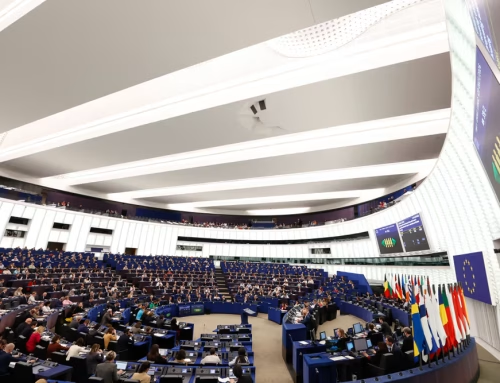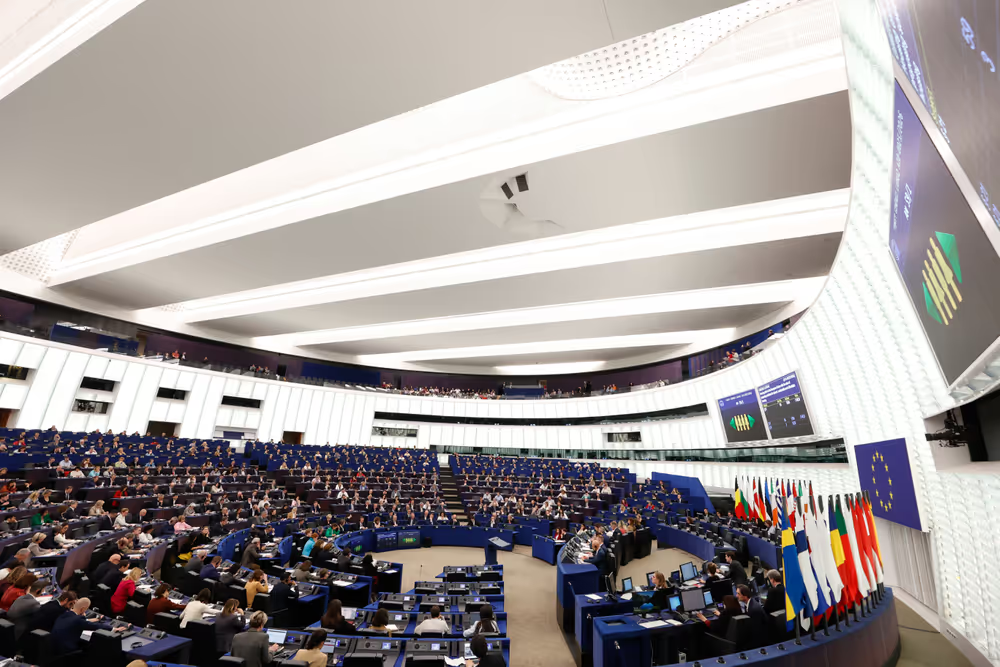
A new study published by the European Parliament examines how the United States is reshaping its critical minerals policy and what this could mean for the European Union’s strategic autonomy, industrial competitiveness and security.
The study, US critical minerals policy and its implications for the EU’s strategic autonomy, was jointly prepared by the European Parliament ’s Policy Department for Economy and Growth and its Policy Department for Transformation, Innovation and Health. It analyses the evolution of US critical minerals policy from 2017 to 2026 and compares it with the EU approach, paying particular attention to funding, strategic stockpiling, price-support mechanisms and supply-chain resilience.
Processing capacity: a key strategic vulnerability
One of the study’s main findings is that the greatest vulnerability in critical raw material (CRM) supply chains is not necessarily access to mineral resources themselves, but the capacity to process and refine them.
The study divides CRM value chains into four main areas: upstream extraction, midstream processing, downstream manufacturing, and recycling. It identifies the midstream stage as a major strategic bottleneck, due to the strong geographical concentration of refining and processing capacity. China, for example, controls around 90% of rare earth refining and approximately 74% of lithium and cobalt refining.
This finding is particularly relevant for Europe. Developing new mines or diversifying raw material suppliers alone will not eliminate strategic dependencies. According to the study, these efforts need to be accompanied by investment in European processing, refining and intermediate manufacturing capacity.
Different approaches
The study also identifies important differences between the US and EU policy models. The United States has increasingly moved towards direct public intervention in critical mineral markets, combining tax incentives, industrial funding, strategic reserves, trade measures and international partnerships. Since 2025, this approach has become more interventionist, with greater use of executive powers and direct support for domestic processing projects.
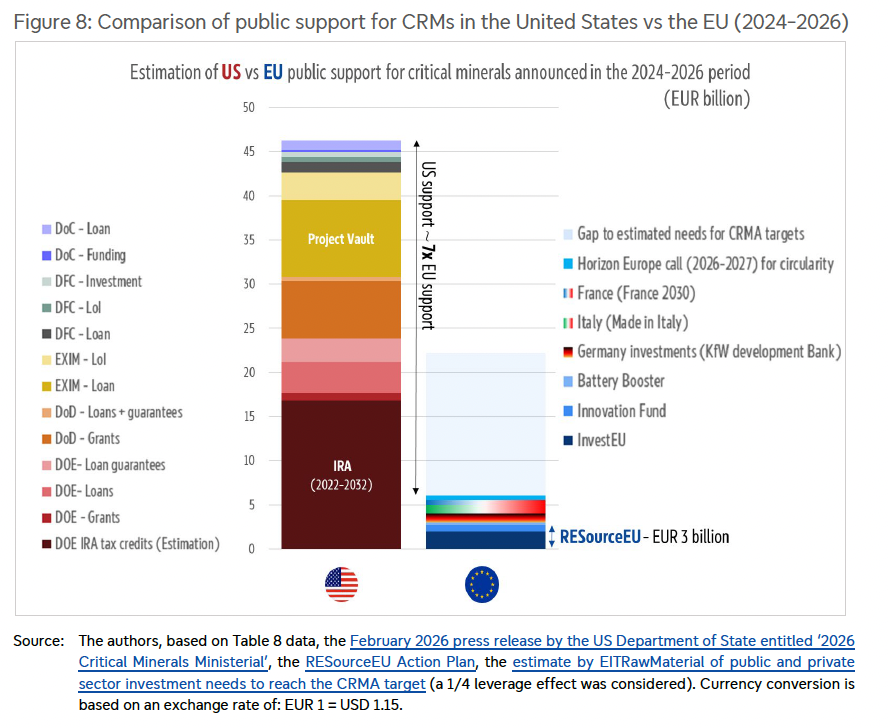
A particularly significant difference concerns financing. The study estimates that US federal agencies mobilise around EUR 46 billion in support for critical minerals, compared with approximately EUR 5–6 billion in the EU. It also notes that US support tends to involve larger and more flexible instruments with greater public risk-sharing, while EU funding relies mainly on grants and loans.
The two regions also differ in their approach to strategic stockpiling and price stabilisation. While the United States already operates strategic reserve mechanisms, the EU is still developing its stockpiling framework. The study also points to instruments such as Contracts for Difference (CfDs) as a possible way to provide greater long-term revenue certainty for European mining and processing projects.
Why this matters for SCIMIN-CRM
The findings are closely connected to the challenges addressed by SCIMIN-CRM. Strengthening Europe’s CRM resilience requires a comprehensive understanding of the entire value chain, from extraction and processing to manufacturing and recycling.
The study reinforces the importance of developing European capabilities, improving supply-chain knowledge and monitoring dependencies as they evolve. It also stresses that criticality is dynamic: technological change, new industrial demand, geopolitical developments and export restrictions can rapidly change which materials and value-chain stages are most vulnerable.
For Europe, building greater strategic autonomy in critical raw materials will therefore depend not only on securing access to resources, but also on strengthening industrial capacity, investment and coordination across the full CRM value chain.