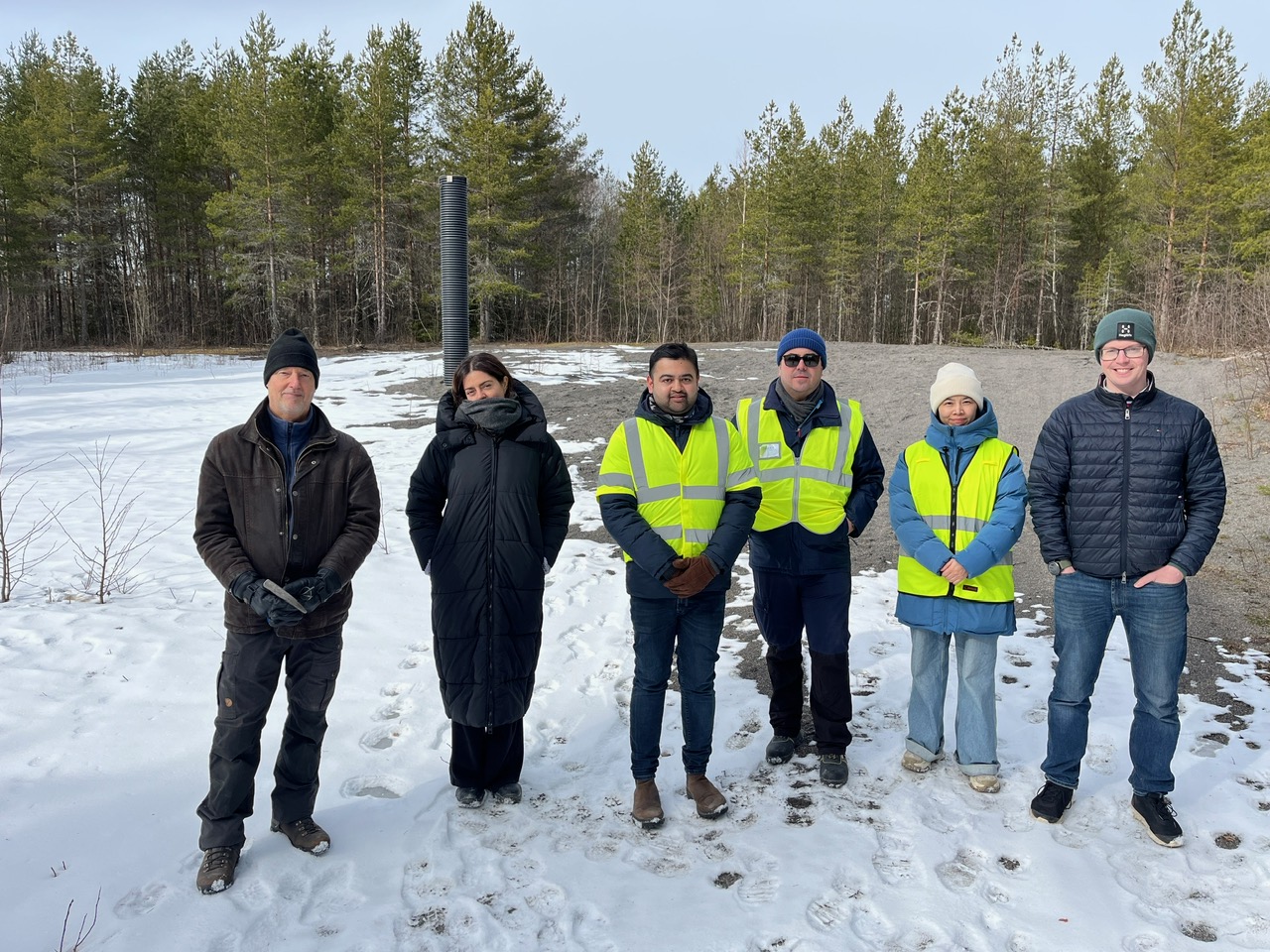

From 16 to 18 March, the SCIMIN-CRM, funded by the European Commission, project management team from ANEFA traveled to Sweden to visit one of the project’s key pilot sites: Grängesberg, located near the town of Ludvika, approximately three hours by car from Stockholm.
This technical visit provided an opportunity for the ANEFA team to meet with researchers from Chalmers University of Technology and the lead geologist from Grängesberg Exploration AB, who is responsible for the pilot site. Throughout the visit, discussions focused on the characterization of historical Mining Waste Facilities (MWFs) and their potential to recover critical and strategic raw materials, such as apatite, which can be found in the fine fraction of the iron ore tailings.

Although a wintry landscape was expected at this time of year, the unseasonably mild weather allowed for a detailed visit to the pilot area. The team explored significant mineral outcrops and received an in-depth explanation of the geological formation, including the chance to examine samples from various parts of the deposit.
The site is not currently in production but does host an active aggregates operation. The MWFs that will be studied were deposited decades ago and have since become fully integrated into the natural landscape, now covered by a typical Swedish forest indistinguishable from the surrounding area.

This visit marks an important milestone in the SCIMIN-CRM project, which aims to develop a fast-track methodology for the efficient and reliable assessment of the potential for recovering critical raw materials from legacy mining sites. Insights gained in Grängesberg will be key to testing and refining this innovative fast path.
Through this technical mission, ANEFA reinforces its commitment to innovation and sustainability in the aggregates sector, contributing actively to European efforts in resource recovery and improved management of historical mining legacies.